 Thales Maciel
dd2813340b
Thales Maciel
dd2813340b
Stop implying that one Ubuntu 3.11 unit lane validates the full Linux support surface Aman documents.\n\nSplit CI into an Ubuntu CPython 3.10/3.11/3.12 unit-package matrix, a portable install plus doctor smoke lane, and a packaging lane gated on both. Add a reproducible ci_portable_smoke.sh helper with fake systemctl coverage, and force the installer onto /usr/bin/python3 so the smoke path uses the distro-provided GI and X11 Python packages it is meant to validate.\n\nUpdate the README, release/distribution docs, and Debian metadata to distinguish the automated Ubuntu CI floor from broader manual GA signoff families, and add the missing AppIndicator introspection package to the Ubuntu/Debian dependency lists.\n\nValidate with python3 -m unittest discover -s tests -p 'test_*.py', python3 -m py_compile src/*.py tests/*.py, and bash -n scripts/ci_portable_smoke.sh. The full xvfb-backed smoke could not be run locally in this sandbox because xvfb-run is unavailable.
6.5 KiB
aman
Local amanuensis for X11 desktop dictation
Aman is a local X11 dictation daemon for Linux desktops. The supported path is: install the portable bundle, save the first-run settings window once, then use a hotkey to dictate into the focused app.
Published bundles, checksums, and release notes live on the
git.thaloco.com releases page.
Support requests and bug reports go to
SUPPORT.md or thales@thalesmaciel.com.
Supported Path
| Surface | Contract |
|---|---|
| Desktop session | X11 only |
| Runtime dependencies | Installed from the distro package manager |
| Supported daily-use mode | systemd --user service |
| Manual foreground mode | aman run for setup, support, and debugging |
| Canonical recovery sequence | aman doctor -> aman self-check -> journalctl --user -u aman -> aman run --verbose |
| Automated CI floor | Ubuntu CI: CPython 3.10, 3.11, 3.12 for unit/package coverage, plus portable install and aman doctor smoke with Ubuntu system python3 |
| Manual GA signoff families | Debian/Ubuntu, Arch, Fedora, openSUSE |
| Portable installer prerequisite | System CPython 3.10, 3.11, or 3.12 |
Distribution policy and user persona details live in
docs/persona-and-distribution.md.
The wider distro-family list is a manual validation target for release signoff. It is not the current automated CI surface yet.
60-Second Quickstart
First, install the runtime dependencies for your distro:
Ubuntu/Debian
sudo apt install -y libportaudio2 python3-gi python3-xlib gir1.2-gtk-3.0 gir1.2-ayatanaappindicator3-0.1 libayatana-appindicator3-1
Arch Linux
sudo pacman -S --needed portaudio gtk3 libayatana-appindicator python-gobject python-xlib
Fedora
sudo dnf install -y portaudio gtk3 libayatana-appindicator-gtk3 python3-gobject python3-xlib
openSUSE
sudo zypper install -y portaudio gtk3 libayatana-appindicator3-1 python3-gobject python3-python-xlib
Then install Aman and run the first dictation:
- Download, verify, and extract the portable bundle from the releases page.
- Run
./install.sh. - When
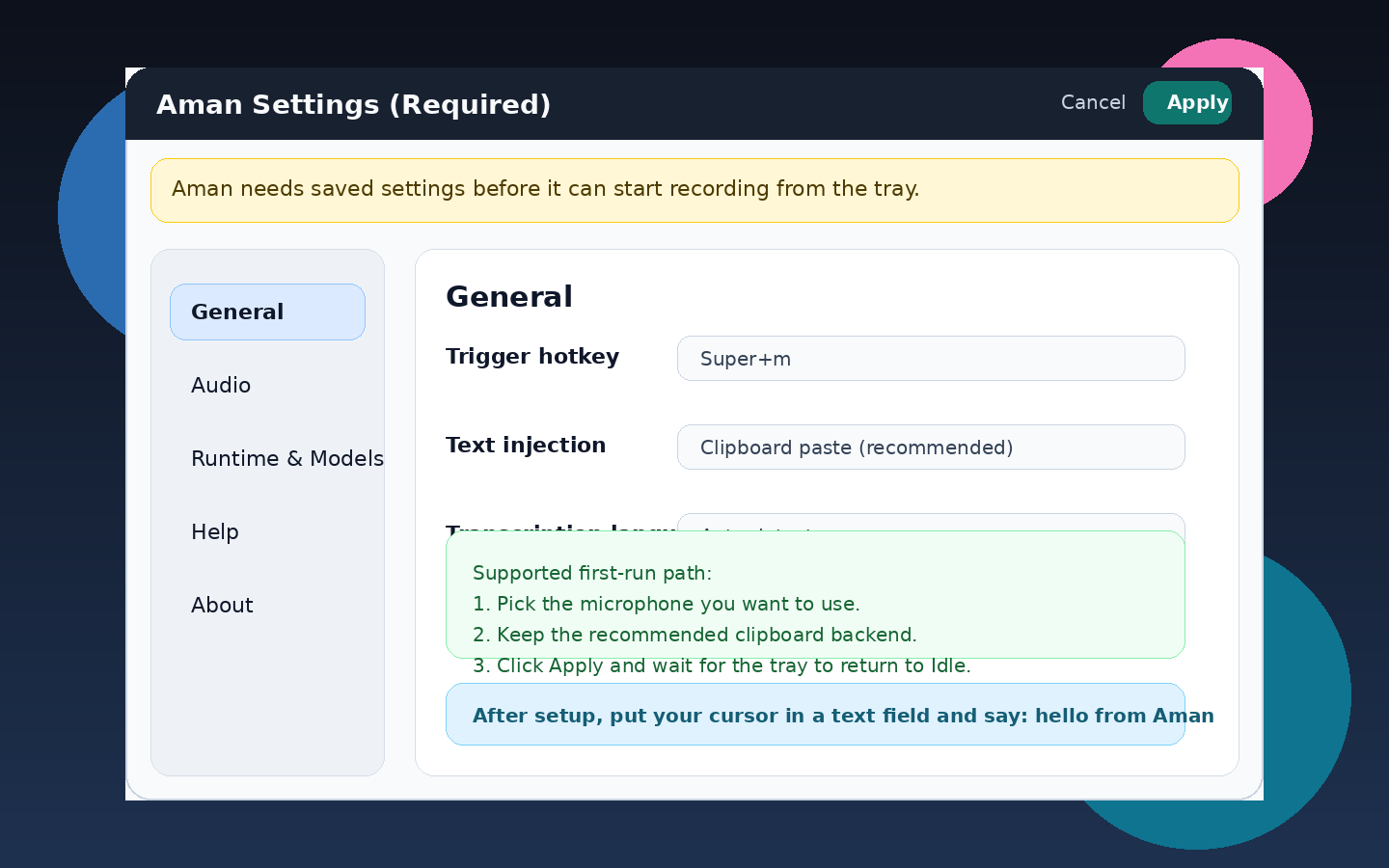
Aman Settings (Required)opens, choose your microphone and keepClipboard paste (recommended)unless you have a reason to change it. - Leave the default hotkey
Cmd+munless it conflicts. On Linux,CmdandSuperare equivalent in Aman, so this is the same modifier many users callSuper+m. - Click
Apply. - Put your cursor in any text field.
- Press the hotkey once, say
hello from Aman, then press the hotkey again.
sha256sum -c aman-x11-linux-<version>.tar.gz.sha256
tar -xzf aman-x11-linux-<version>.tar.gz
cd aman-x11-linux-<version>
./install.sh
What Success Looks Like
- On first launch, Aman opens the
Aman Settings (Required)window. - After you save settings, the tray returns to
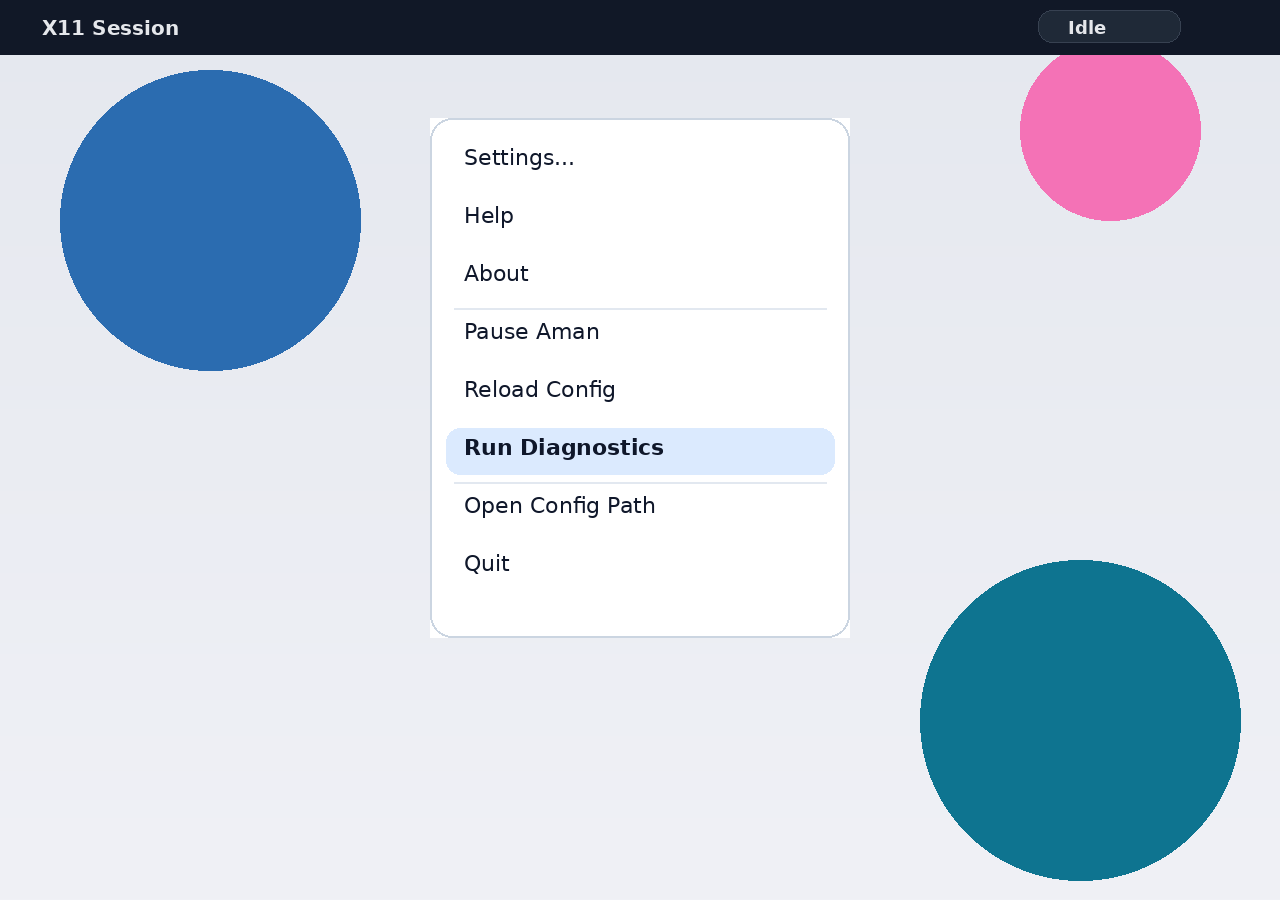
Idle. - During dictation, the tray cycles
Idle -> Recording -> STT -> AI Processing -> Idle. - The focused text field receives text similar to
Hello from Aman.
Visual Proof
Watch the first-run walkthrough (WebM)
Validate Your Install
Run the supported checks in this order:
aman doctor --config ~/.config/aman/config.json
aman self-check --config ~/.config/aman/config.json
aman doctoris the fast, read-only preflight for config, X11 session, audio runtime, input resolution, hotkey availability, injection backend selection, and service prerequisites.aman self-checkis the deeper, still read-only installed-system readiness check. It includes everydoctorcheck plus managed model cache, cache writability, service unit/state, and startup readiness.- Exit code
0means every check finished asokorwarn. Exit code2means at least one check finished asfail.
Troubleshooting
- Settings window did not appear:
run
aman run --config ~/.config/aman/config.jsononce in the foreground. - No tray icon after saving settings:
run
aman self-check --config ~/.config/aman/config.json. - Hotkey does not start recording:
run
aman doctor --config ~/.config/aman/config.jsonand pick a different hotkey in Settings if needed. - Microphone test fails or no audio is captured:
re-open Settings, choose another input device, then rerun
aman doctor. - Text was recorded but not injected:
run
aman doctor, thenaman run --config ~/.config/aman/config.json --verbose.
Use docs/runtime-recovery.md for the full failure
map and escalation flow.
Install, Upgrade, and Uninstall
The canonical end-user guide lives in
docs/portable-install.md.
- Fresh install, upgrade, uninstall, and purge behavior are documented there.
- The same guide covers distro-package conflicts and portable-installer recovery steps.
- Release-specific notes for
1.0.0live indocs/releases/1.0.0.md.
Daily Use and Support
- Supported daily-use path: let the
systemd --userservice keep Aman running. - Supported manual path: use
aman runin the foreground for setup, support, or debugging. - Tray menu actions are:
Settings...,Help,About,Pause Aman/Resume Aman,Reload Config,Run Diagnostics,Open Config Path, andQuit. - If required settings are not saved, Aman enters a
Settings Requiredtray state and does not capture audio.
Secondary Channels
- Portable X11 bundle: current canonical end-user channel.
- Debian/Ubuntu
.deb: secondary packaged channel. - Arch
PKGBUILDplus source tarball: secondary maintainer and power-user channel. - Python wheel and sdist: developer and integrator channel.
More Docs
- Install, upgrade, uninstall: docs/portable-install.md
- Runtime recovery and diagnostics: docs/runtime-recovery.md
- Release notes: docs/releases/1.0.0.md
- Support and issue reporting: SUPPORT.md
- Config reference and advanced behavior: docs/config-reference.md
- Developer, packaging, and benchmark workflows: docs/developer-workflows.md
- Persona and distribution policy: docs/persona-and-distribution.md